Pages

We have moved! You should be redirected to thelicentiate.com in a few seconds. This blog will not be updated. Click here if you are not redirected
Showing posts with label Fashion. Show all posts

Tuesday, June 14, 2011

The Last Picture Show: The most stylish film you've never heard of

Showing this week at the Triskel is Peter Bogdanovich's classic The Last Picture show, which celebrates it's 40th birthday this year.

It's one of my favourite films.  Based in rural Texas is the early 1950's (an incredibly baby-faced) Jeff Bridges and Timothy Bottoms star as two high-school seniors poised on the brink of a very depressing adulthood.  It's sad and it's beautiful and it's painfully real

The set designs and costumes by Bogdanovich's wife Polly Platt (he would later leave her for Cybill Shepard, the ingenue of the film - she apparantly had affairs with Bridges and Bottoms during filming as well, which must have been a fun environment to work in) are some of the best to be seen in films and marked a turning point for realism in the cinema. 

Up until 1970, costumes for period dramas were pretty contrived.  Platt made the characters look realistic and unobtrusively stylish at the same time, which complements Bogdanovich's genius eye for a composition.  At the time of filming Orson Welles was living with Bogdanovich and Platt and I think the influence really shows.  Here are a few pictures.

This film is every west-coast style blogger's inspiration; slouchy cool and a touch of urban decay and general apathy.  It looks a bit like  Band of Outsiders lookbook - forty years before Band of Outsiders was even thought of.
Photobucket

Photobucket

Photobucket

Photobucket

Photobucket

Photobucket

Photobucket

Photobucket

Photobucket

Photobucket

Photobucket

Photobucket

Photobucket

Sunday, June 12, 2011

Debbie Reynolds' costume auction

On the 18th of June, Debbie Reynolds (from Singin' in the Rain and also known as Carrie Fisher off Star Wars' overbearing mother) will be auctioning off her collection of film costumes and memorobilia.  She initially tried to find a single museum buyer but, sadly, that didn't happen and now her huge collection will be sold off piecemeal.

I really hope that some of her items do turn up in a museum, because she owns some astonishing stuff, like Charlie Chaplin's bowler hat, Laurel and Hardy's suits, dresses worn by Audrey Hepburn in My Fair Lady, that dress worn by Marilyn Monroe in The Seven Year Itch (you know the one...) and a pair of Dorothy's ruby slippers.

She also has the curtain-material playsuits worn by the Von Trapp Family Singers in The Sound Of Music.  Joy.  Actual joy.

You can download the catalogue online.  Here are a few items I would buy for sentimental or pure greedy reasons if I had the funds.  This is just a small smattering, because the catalogue is a whopping 319 pages long. 

Thanks to Penny Dreadful Vintage for bringing this to my attention.
Photobucket
Marion Davies monumental oil painting by Federico Beltran Masses from Davies’ estate

Photobucket
'Messala' historic winged charioteer helmet rom the 1925 Ben-Hur: A Tale of the Christ

Photobucket
Left - Eleanor Powell “Clare Bennett” black velvet jacket designed by Adrian in Broadway Melody of 1940. Right - Jean Hagen “Lina Lamont” camel coat with monkey-fur collar from Singin’ in the Rain.

Photobucket
Carole Lombard 'Connie Randall' gown by Travis Banton from No Man of Her Own

Photobucket
Left - Debbie Reynolds “Kathy Selden” green & white leaf patterned sleeveless dress from Singin’ in the Rain. Right - Ginger Rogers “Dinah Barkley” gold lamé dress from Barkleys of Broadway

Photobucket
Rita Hayworth “Maribelle Hicks” two-piece dress from Cover Girl.

Photobucket
Left - Susan Hayward “Jane Froman” pastel rainbow-hued ball gown from With a Song in My Heart, right - Jane Wyman “Belinda McDonald” green dress and tan sweater from Johnny Belinda.  If you haven't seen Johnny Belinda, watch it asap.  You will cry buckets.

Photobucket
Emerald-green felt “Ozmite” jacket designed by Adrian from The Wizard of Oz.
Photobucket
Go on, guess which film these costumes are from.


Photobucket
Cleopatra large-scale original concept painting of Elizabeth Taylor “Cleopatra” in her Alexandria apartment

Photobucket
Cleopatra large-scale original concept painting of Antony and Cleopatra on her royal barge by Ed Graves

Photobucket
Cleopatra large-scale original concept painting of a harbor scene by Duilio Savina

Friday, June 10, 2011

Related #5: Clothing as Memory

If you read yesterday's post, then you'll know what this photo is about.

Photobucket
This photo was restored by one of my aunt's friends after she posted the picture on facebook - a really nice gesture.  My grandfather would have been 85 last week.  He was born on the same day as Marilyn Monroe.  Truefax.

I'm usually fine with people reblogging my pictures, but this is a family photo, so please don't copy and paste this. If you like it, then share the link. Thank you.

Thursday, June 9, 2011

Licentiate Column 09/06/11: Clothing as Memory

How do you remember people? Do you use mnemonics, or acronyms or mind mapping? Or are you one of those people who has an eye for the little details? Is it the face you remember, or the voice, or the perfume?
Memory is a funny thing. Anything can trigger a once-buried picture into either painful or joyous resurrection from the deepest, darkest regions of the hippocampus or temporal lobe.

In a hens-teeth email from my father (as in ‘as rare as..’) he wondered what images of him were built in the minds of close friends and family.

We had just been sent a picture of my grandparents when they were both very young. My grandfather is impossibly chiseled in white tie and tails. My grandmother is radiant in floor length chiffon, blissfully unaware of just how many children she’s going to have. It is Christmas Eve. She is sporting a brand new engagement ring. They are both very happy.

They are not the parents my father remembers. He remembers my grandfather with a perpetual cigarette in his right hand. I barely remember him, because he died when I was very small.

It’s the little details that you remember, the trivia that acts as infill and enriches the bigger pictures. You might remember a person’s filthy anecdotes, you might remember their grating verbal tics. All of it adds up to a memory. I remember a person’s clothes.

It might seem shallow to see the world through material things (in both the literal and figurative sense) but your memory glues itself to the aspects of a person to which you pay the most attention. It seems that I’ve been a clothes monomaniac since conception.

My father? Shirts. Floral shirts form Liberty, stripes by Paul Smith. My mother? Black Agnes b and rows of jersey wrap dresses hanging in their dry cleaning bags. My brother is tracksuit pants occasionally tucked into socks, my sisters are cocktail dresses and bright, Alexander Wang-ish vests, the collars slightly blemished by the odd dab of foundation. My mother’s mother is a pair of neatly ironed slacks in stone and olive.

It’s this way of thinking that leads me and many others to believe in the importance of vintage clothing. Every piece tells a story. It might mean nothing you you, but that tie belonged to a father, a brother. Even though they may have discarded it, it can still hold some powerful and distinctive memories for another person (if not a powerful and distinctive odour). That Penneys top may be super-cheap and on-trend, but is it really that special? Is it the stuff that memories are made of?

This isn’t a diatribe against cheap clothing and for designer goods, it’s a call to realise how important old clothes are. Because, when a loved one leaves you, what are you left with? There’s you. There is a full, yet empty wardrobe. And there are your memories.

Tuesday, May 31, 2011

African Wax Fabrics

My first proper boyfriend lived in Ghana for a year.  In our emails back and forth he would tell me about the food, the nightlife and the time he drunkenly passed out at a party at the Irish Consulate in Accra. 

Reading back over his emails from five years ago, it's clear that Ghana is an incredible country with Everest-type highs and supertrough lows.  Floods, typhoid and the odd Internet cafe going on fire are recurring motifs in the emails.  But then again, so are friendly, welcoming people, sporting tradition and the merits of river boiled kenki.

He never told me about the fabric though.

Photobucket

Wax fabric is predominantly made in Ghana and is responsible for some of the trippiest, brightest, graphic prints available in the world today.  The prints can be abstract, but are usually full of signs and symbols denoting a persons social status, political affiliations or general likes.

African art has a tendency towards the literal and these prints follow on from that.  With the popularisation of wax printing, more and more prints are devoted to technology and commerce.  You can buy Pop Art-ish yards of fabrics stamped with lipsticks, batteries, car mufflers, chickens and irons.

Photobucket

I love the pure, flat joy of these prints.  It's only a matter of time before a label like Proenza Schouler or Erdem picks these brights up and works them into a Spring/Summer collection (fingers crossed). 

There are already Western designers that work with these fabrics, but I'm yet to see a top or dress that justifies the fabric and brings out the best in it.  Is it just me or is a lot of this clothing, I don't know, a little bit... patronising?  Or self-congratulatory?  People need to get out of the mindset that Africa is synonymous with charity - then we'll stop treating their indigenous goods like another person's cast-offs and give it the shape and beauty these prints deserve.

To see more, go to the African Fabric Flickr pool

Photos 1-4 from here.  Photos 5-8 from here.

Sunday, May 22, 2011

Théâtre de la Mode

I saw these on How To Be A Retronaut and they were too good not to share.

The Théâtre de la Mode was brought about at the liberation of Paris in 1944. Parisian fashion houses were only just starting to re-open their doors after several years of limited or non-production.

The purported story is that there wasn't enough fabric to make full-scale dresses, so two feet tall wire models were kitted out with the finest in couture and displayed, first in Paris, then around Europe and North America until their acquisition by the Maryhill Museum of Art in Washington.

More than likely, it was a more cost-effective way to remind the world that Paris was still the epicentre of fashion, despite living through occupation, starvation, oppression and war. While fabric was rationed and still at a premium (especially silk, which was used for parachutes), Parisian women defied the Germans in any way they could, usually by flouting stringent material rationing and wearing dresses and skirts made with yards and yards of whatever they could get their hands on.

Breaking the law and looking chic at the same time - those Parisian women knew their stuff.

The first five photographs were taken by David Seidner in 1990. He deliberately set the dolls in a recognisably French, warlike background. At first, I thought that these photos were taken in the 1940's. In actuality, all 237 (!) dolls were put on display in 1944 as part of a number of scenarios designed by artists like Jean Cocteau, amongst others.

Photobucket
David Seidner, Lucien Lelong, 1990

Photobucket
David Seidner, Balenciaga, 1990

Photobucket
David Seidner, Marcel Dhorme, 1990

Photobucket
David Seidner, Madame Gres, 1990

Photobucket
David Seidner, Robert Piguet, Raphaël, Pierre Balmain, 1990

Photobucket
Jean Cocteau's 1944 setting, Ma Femme  est une Sorcière (source)
For more info, read Theatre de la Mode

Monday, May 16, 2011

Kinda Sorta Love...

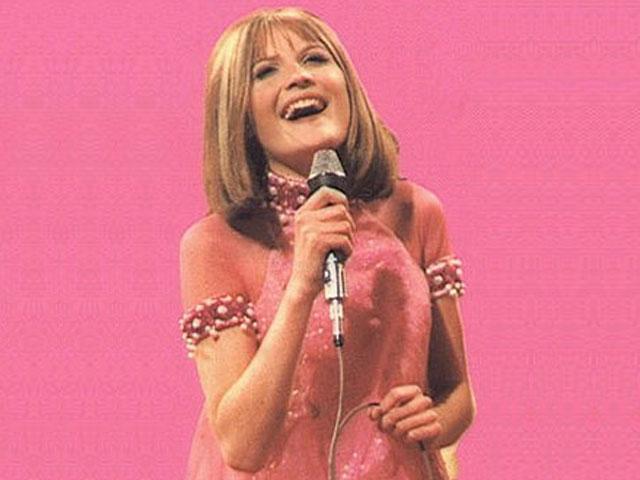
...The Eurovision, which for one night only turns everything the most amazing shade of camp.  This is the Serbian entry Nina, who sang... er, I have no idea.  In my mind, it sounds a bit like this.


Source

Need more pictures of this act. Source
  Coloured tights, bright colours, patterns, sharp bobs, heavy eye make-up, micro minis.  Remind you of anyone?

Sandie Shaw, Eurovision winner 1967.  Source

Friday, May 13, 2011

Related #1: Fashioning Nightwear

Every so often, I write a column where five hundred words just isn't enough.  There's all kinds of pictures and resources that I would love to share.  I'm starting a series of posts the day after each column comes out in print (ehm, that's Friday then) with some supplementary material.  It won't ebe every Friday, but it will be a recurring thing.

If you read yesterday's post, then you'll know that I don't really take nightwear too seriously.  I do, however, have huge love for pajamas.  Pajamas are great.  The best pajamas are the sartorial equivalent of a hug.  The ultimate in loungewear, a nice pair of a pajamas is only one point in the triangle of the perfect relaxing winter evening (the other two points being a hot drink and a good book).

Here's some pajama related information and inspiration.


The Poetry of Pajamas by A.K MacDonald
When Pajamas Weren't the Cat's Pajamas.. Or Were They? from Here's Looking at You, Kid.

Vintage Fashion Guild Guide to Pajamas.

Photobucket
Pauls Stuart Pajamas, the pajama grandaddy (source)

Photobucket
Claudette Colbert in Clark Gable's PJs from It Happened One Night.

Lana Pajama Rama (more here)

Photobucket
1940's Pajama Set from Japan from Moonchild Vintage at Etsy.


Photobucket
Candy Dream 1950's pajamas from Lasthouse at Etsy (very tempted to buy these).


Photobucket
1980's Cabana pajamas from A Hula Girl at Heart at Etsy.